
By Chiara Gambardella & Carlotta Santolini
The Mediterranean spearfish (Tetrapturus belone) is one of the great pelagic predators of the Mediterranean Sea. With its streamlined body, moderately long bill, and remarkable speed, it is clearly built for life in the open sea. Anglers, especially sport fishers, know it well, yet from a scientific perspective it has long remained understudied.
For many years, most of the available information on this species was based almost exclusively on catch data, often incomplete. Direct data on its movements and habitat use were lacking. Without this knowledge, it is difficult to fully understand the biology of the species or to design effective management strategies.
Why study the Movements of the Mediterranean Spearfish?
Understanding where a top predator moves also helps us better understand the sea it inhabits. Species like the Mediterranean spearfish are not tied to a single location; they move in response to favorable environmental conditions and prey availability. In the Mediterranean, a complex basin heavily influenced by human activities, these movement patterns may shift over time.
The study by Malara et al. (2024) was designed precisely to fill this knowledge gap, using advanced technology and close collaboration with the fishing community. The goal was both simple and ambitious: to track Mediterranean spearfish movements and understand how they use space and the water column.
From Anglers to Satellite Tagging
To reconstruct the movements of Mediterranean spearfish, researchers used pop-up satellite archival tags (PSATs). These devices are attached to the fish and record environmental and behavioral data. After a programmed period, they detach automatically and transmit the collected information via satellite.
In the study, six spearfish were captured, tagged, and released in different areas of the central Mediterranean, including the Strait of Messina, the Tyrrhenian Sea, and northwestern Sicily.
Collaboration with fishers, including recreational anglers, was fundamental to the fieldwork. This approach fits into a broader framework of citizen science applied to large pelagic species, supported by organizations such as the International Game Fish Association, which has long promoted tagging programs and cooperation between sport fishing and scientific research.
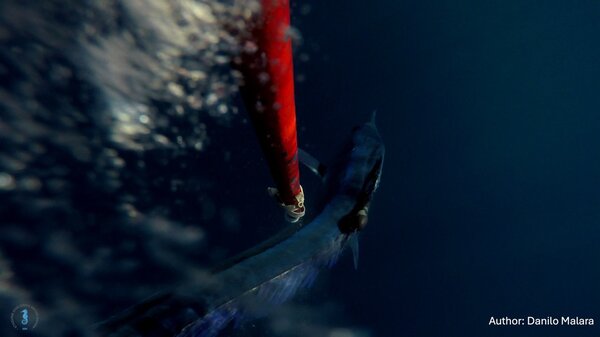
Figure 1-Photo of a Mediterranean spearfish tagged in this study.
Where Does the Mediterranean Spearfish Move?
By tracking the tagged individuals, researchers were able—for the first time—to observe how this species uses the Mediterranean basin. The data show that the Mediterranean spearfish does not remain confined to a small area, but moves across the central basin throughout the year, particularly frequenting regions such as the Tyrrhenian Sea and the Strait of Sicily.
These movements confirm that it is a highly mobile species, using different environments at different times, likely in response to environmental conditions and prey distribution. This helps explain why the species is encountered in different areas and seasons.
The data also revealed how the spearfish uses the water column. Most of its time is spent near the surface, where it is more easily intercepted by fisheries. However, individuals are also capable of deep dives beyond 200 meters, demonstrating considerable adaptability.
Finally, the study highlighted a preference for relatively warm waters, with frequent vertical movements between surface and deeper layers. In a Mediterranean Sea that is warming rapidly, this information is crucial to understanding how the species’ behavior may change in the future.

Figure 2- Representation of Mediterranean area use across the four seasons. Figure adapted from Malara et al., 2024.
The Role of Recreational Fishing in Research
One of the most important messages of this study is the value of collaboration with fishers. Without the direct contribution of the fishing community, particularly recreational anglers, research of this kind would be far more difficult to carry out.
Stronger dialogue between science and fisheries is essential to building more informed and sustainable marine resource management.
Other related news

12/11/2025
Summer Barbel: Feeder Fishing on the Ticino River

12/01/2026
Bottom Fishing for Everyone

06/12/2025
Squid time
15/07/2025
Spanish Carp on the Fly

01/07/2026
Carpfishing in open waters

31/07/2026
Carpfishing: never give up!

01/12/2025
Expedition Predator Youtube Challenge

03/12/2025
Fishing Beyond Limits

23/02/2026
The lure you can’t buy

23/02/2026
From Sea to Data: When Recreational Fishing Becomes Science

23/02/2026
When the Sea Changes: Alien Species First Spotted by Fishers

22/11/2025
Ireland, land of pike and dreams

23/02/2026
Carpfishing

08/12/2025
The great challenge
01/10/2025
Catfish angling from a belly boat

13/01/2026
Cape Verde, the paradise of fishing