
Hi everyone! Today I’d like to share an article with you on one of the topics we focused on most during the last edition of Pescare Show: spinning for sea bass.
This technique was the subject of most of our conversations among enthusiasts, as well as the topic of several interviews.
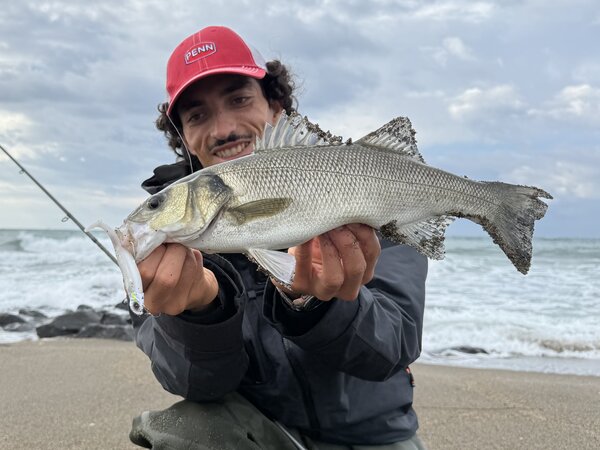
In this article, I want to focus on a specific approach to sea bass spinning: fishing from the rocks.
Without a doubt, this technique is one of the aspects of spinning that requires the most research, but also incredible passion and dedication, spending long hours fishing, testing spots, and studying the tides and moon phases.
To justify the first blank days, the mere scent of salt in the air and those unique natural landscapes would be enough. But since we are die-hard spinning enthusiasts, we want to live the experience to the fullest—catching the Queen of our seas.
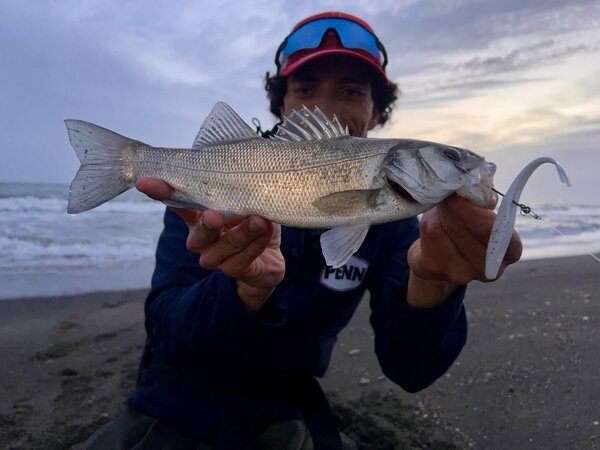
The sea bass is one of the predatory fish that fascinates me the most.
Its unpredictability and incredible elegance have always been a true magnet, constantly drawing me toward it. I’ve never doubted why some anglers are completely devoted to pursuing this marine species.
Alas, it’s a technique that I practiced only sporadically when I was younger, due to many blank days and the theoretical complexity of this method, focusing instead on other species like black bass.
However, you never forget your first sea bass, and I remember mine perfectly.
It was December 27, 2011. I was 14 years old and fishing with my cousin Lorenzo on one of the local rocky shores. After many blank days, I refused to give up and kept returning to the same spot whenever a swell was coming, unaware of how much the moon and tides could affect fish behavior.
I was fishing in the foam with an 11-centimeter white jerkbait when I felt a huge strike, followed by an epic fight. I couldn’t believe my eyes. I had finally caught my first spinning sea bass—a superb 2-kilo fish!
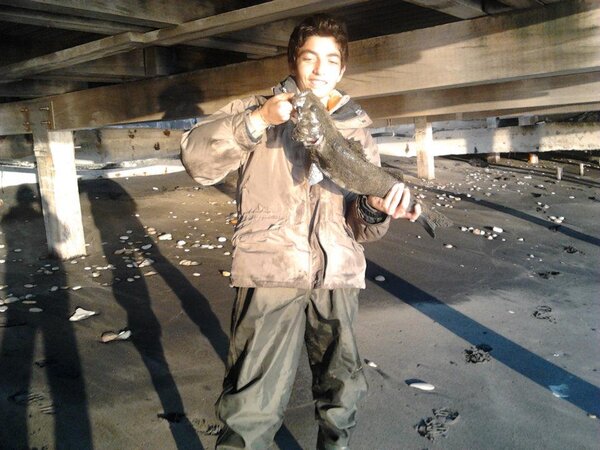
May this short story encourage you to keep going even if you’re experiencing one blank after another, or, if you’re considering fishing for sea bass from the rocks, go for it!
That said, let’s move on to the more substantial part of this article. With this piece, I want to share what I’m learning and what is giving me most of my catches.
Over the past year, I’ve decided to dedicate myself more to hunting the Queen from the rocks, and by comparing notes with great sea bass anglers (like the dear Giacomo Capresi), I’ve started to see things more clearly and better contextualize my catches.
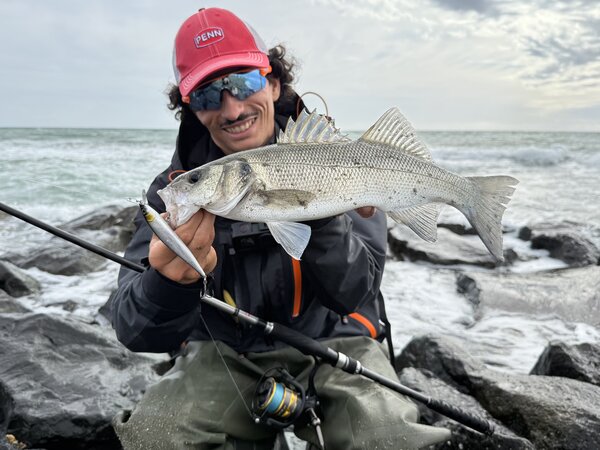
I’ve noticed that most of the spots I frequent deliver the best thrills under specific conditions: a falling tide from the high peak, a swell coming from the south, and a waxing or full moon. These are very important details to note to optimize your fishing (as much as possible). This means that each spot can perform better under certain conditions than others.
Speaking of gear, I use a 2.40-meter spinning rod with a casting capacity of 30 grams. I pair it with a 2500 or 3000-size reel, spooled with good 8-strand 15-pound braid. To finish off, I connect a fluorocarbon leader ranging from 0.28 to 0.40 mm, depending on the specific hazards of the spot I’m fishing.
I always bring a variety of lures, both hardbaits and softbaits. My favorites (starting with hardbaits) are jerkbaits, soft jerks, shads, and shrimp imitations.
I’d also add some topwaters, like WTDs, which in very shallow water and moderate waves can deliver truly unique thrills.
The jerkbait sizes I prefer range from 8 to 13 centimeters. These are the sizes I trust most, given the results I’ve obtained. I use soft jerks, shads, and craws in 3, 4, and 5-inch sizes; both on weighted heads and Texas rigs for snag-resistant setups.
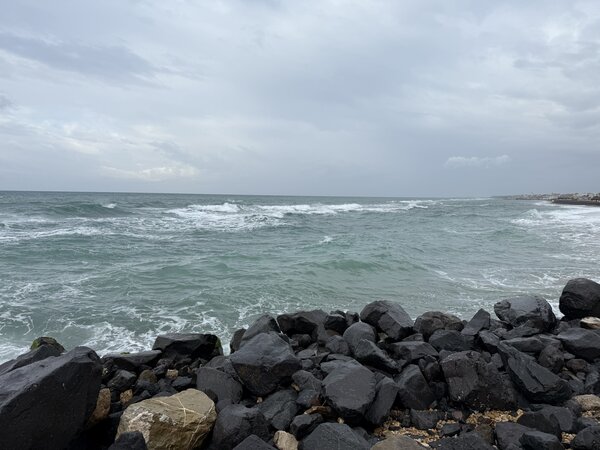
If you have the chance to experience the sea even in autumn and winter, don’t miss the opportunity to chase this species from the beautiful rocky shores that characterize our coasts.
See you at Pescare Show!
Other related news

12/11/2025
Summer Barbel: Feeder Fishing on the Ticino River

12/01/2026
Bottom Fishing for Everyone

06/12/2025
Squid time
15/07/2025
Spanish Carp on the Fly

01/07/2026
Carpfishing in open waters

31/07/2026
Carpfishing: never give up!

01/12/2025
Expedition Predator Youtube Challenge

03/12/2025
Fishing Beyond Limits

23/02/2026
The lure you can’t buy

23/02/2026
Following the Mediterranean Spearfish

23/02/2026
From Sea to Data: When Recreational Fishing Becomes Science

23/02/2026
When the Sea Changes: Alien Species First Spotted by Fishers

22/11/2025
Ireland, land of pike and dreams

23/02/2026
Carpfishing

08/12/2025
The great challenge
01/10/2025
Catfish angling from a belly boat