
Squid fishing is a fascinating discipline that requires knowledge, technique, and the right equipment. It’s not just about casting a line into the water, but about understanding the habits of this cephalopod and adapting your strategy. In this article on squid fishing, I offer you a complete and in-depth overview, revealing tricks and innovations that can revolutionize your approach to this practice. From positioning at sea to choosing the rod, from reading the fish finder to the revolutionary rigs, every aspect is analyzed with expertise.
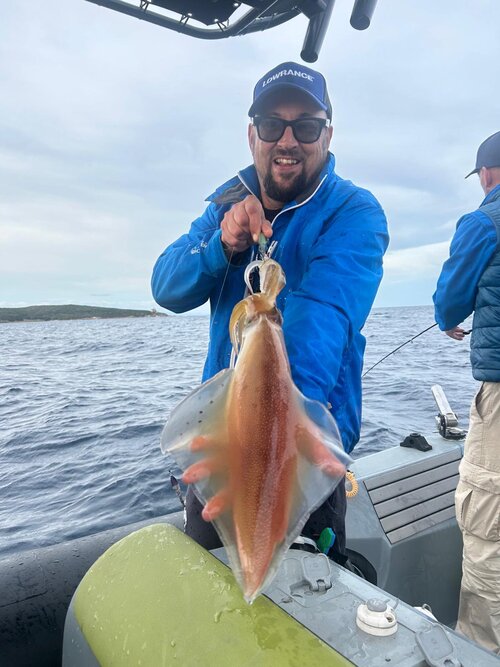
The Squid: A Predator of Our Coasts
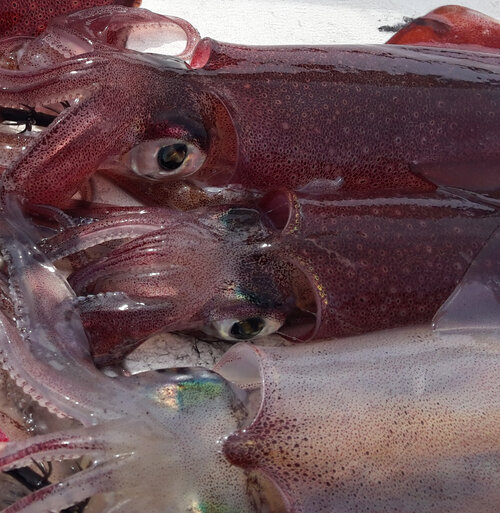
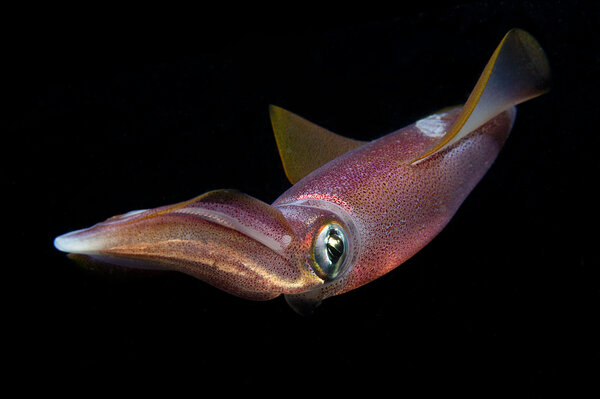
The common squid, Loligo vulgaris, is widespread in our coastal waters and prefers environments that are not excessively warm. Its sensitivity to temperature is remarkable—so much so that in a tank it hardly survives above 27°C. This characteristic influences its distribution and periods of increased activity.
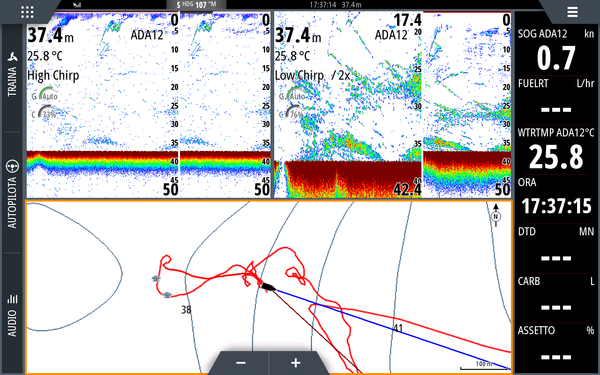
The search for squid is never random. One of the fundamental techniques involves positioning yourself “against the drift,” meaning facing the wind in most cases. Once a mark appears on the fish finder, it is crucial to save that spot with the cursor and then reposition the boat so that the drifting side is the one from which you intend to fish. This method is ideal for drift fishing, a technique different from—and simpler than—the “Bersagliera” method.
Beyond traditional areas, one “secret” revealed in the video is looking for squid on the deeper drop-offs of reefs, zones often fished for other techniques such as live-bait trolling. These areas can provide pleasant surprises, as squid gather there to hunt or rest.
The Fish Finder: The Eye Beneath the Surface
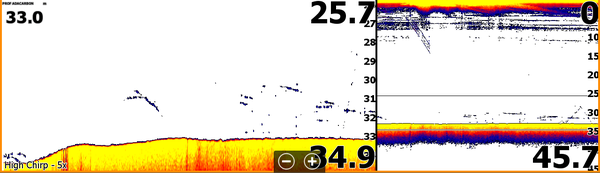
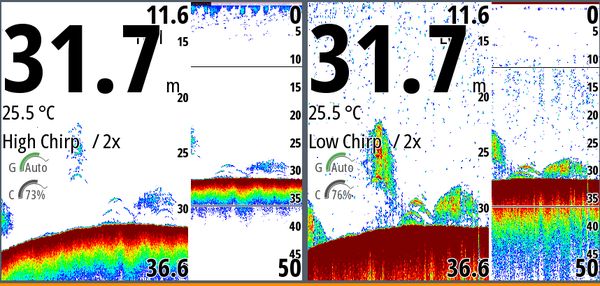
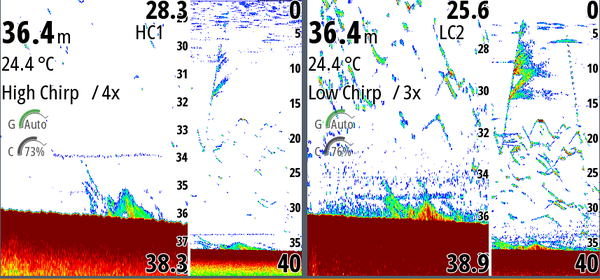
Interpreting the fish finder is an art that improves with experience. Isolated squid on the bottom appear as “dashes” or “light and fairly faint marks,” usually horizontal when the boat is moving very slowly. At higher speeds, they show up as “dots.” The real challenge appears when the area is full of baitfish: distinguishing squid inside dense schools requires eye training and practice. The advice is always to make a drop when in doubt; with time and careful study of screenshots, you will become increasingly skilled in recognizing them.
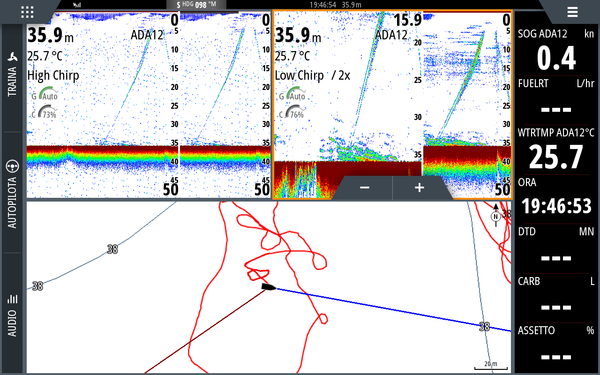
Another essential point: squid do not tolerate murky water. When suspended particles are present, it is advisable to change area or fish at a different depth, as turbidity reduces oxygen and disturbs squid respiration, causing them to avoid such zones.
Equipment: Rod, Reel, and Line
Equipment choice is crucial. I suggest fishing for squid with a rod equipped with a baitcasting reel. The reason is simple: the revolving spool allows the line to descend much faster—an undeniable advantage. I recommend using a very thin braid, PE 0.8 up to a maximum of PE 1, to counter drift effectively and because squid do not require excessive strength.
The rig begins by inserting a “grain of rice” or stopper onto the braid, followed by a soft fluorescent bead. Next, using a Uni knot (at least 13 wraps), tie a large swivel. This swivel is essential for balancing the rig, keeping the tataki straight and aligned in the presence of current, and releasing torsion effectively.
The “Kokeshi” Rod: An Extension of the Arm
I personally developed a very particular squid rod called “Kokeshi,” created specifically for this remarkable type of fishing. This rod stands out for its exceptional action, especially for stimulating “apathetic” squid that bite weakly. Its main feature is the ability to cushion the squid’s reactions, preventing them from coming off due to sudden pulls. With the Kokeshi, the fear of losing squid due to lack of elasticity is almost eliminated, allowing for faster and safer retrieves.
The Kokeshi’s tip is designed to work independently, offering incredible sensitivity. You can clearly feel when the jigs touch the bottom, the type of seabed, and even when the sinker knocks against it. This sensitivity allows for unique movements, such as “shaking the sinker without lifting it” from the bottom, animating the lure irresistibly. The rod acts as a true “extension of the arm,” making fishing feel almost like hand-lining. Its stiffness and tip action allow for the handling of large squid (up to 1 kg) and multiple catches simultaneously, without risking tears.
Tataki Movements and the Big Question: Do Squid Need to Be Set?
One of the most frequent questions among squid anglers is: “Do you need to set the hook?” The video’s answer is a categorical no. Squid flesh is too soft for hook-setting. It is essential to maintain constant tension on the line and retrieve steadily and calmly. The Kokeshi, thanks to its shock-absorbing tip, greatly facilitates this type of retrieval, making the process smoother and reducing losses.
Lure Color: Controversial but Decisive
Another surprising revelation concerns squid vision. Contrary to what one might think, squid perceive the world in black and white. Studies by Japanese biologists have shown that their eyes are specialized for detecting contrasts, as color perception is limited at the depths they typically inhabit.
This means that lure color is still important—but in a different way than traditionally believed. You must think in terms of contrast, considering time of day, depth, and seabed type. To create effective contrast, you need to understand how much light penetrates at depth and how the lure will stand out against the background. This is why “split colors” (for example, a jig with two strongly contrasting colors) work so well.
Additionally, the squid’s body is designed to detect vibrations from prey, similar to the lateral line found in fish. This ability allows them to sense falling lures or approaching prey from long distances, compensating for their limited vision.
Revolutionary Rigs: Chokubula, Bulanko, and Chokketsu
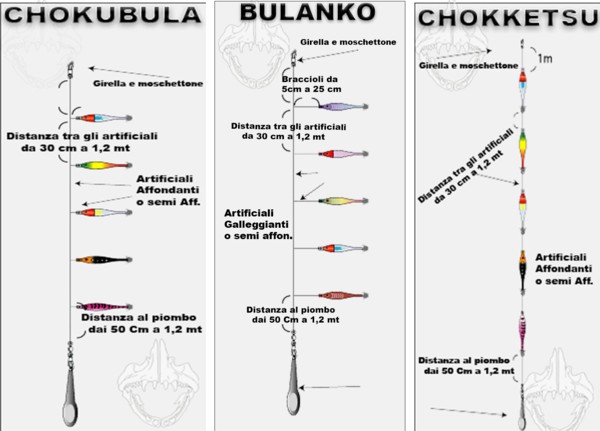
The video dedicates an important section to rigs, explaining the differences and ideal contexts for three main types:
-
Chokubula
The classic rig many anglers are familiar with, where jigs are attached directly to the line “flag style,” without branch lines, using a very tight Dropper Loop. Ideal in light drift or when using a positioning electric motor. -
Bulanko
Very similar to Chokubula, but with a longer Dropper Loop that creates a short branch line. This rig can also be made with technospheres. It is part of “Sasoi” fishing and requires slightly sinking or floating jigs (such as Yamashita Toto Sutte or some DTD models). Sasoi is suitable for faster drift or fishing “passing over” while retrieving with tension. The 5–10 cm branch lines allow the jig to extend better in the current. -
Chokketsu
The true revolution. Chokketsu is a fully inline rig, designed for strong drift and intended for use with specific rods like the Kokeshi. Without a stiff and specialized rod like the Kokeshi, animating the jigs on this rig would be very difficult. Japanese anglers have used it for years, and its effectiveness in challenging conditions is significantly superior to traditional rigs.
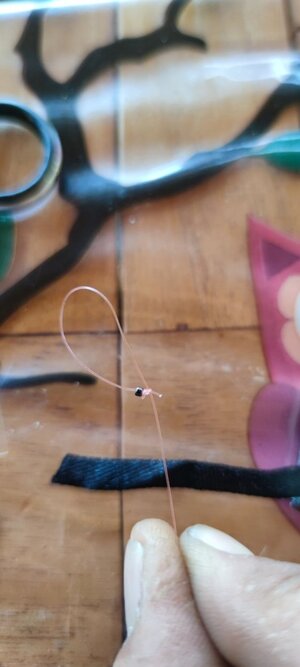
The knot used for Chokketsu is unique and likely unknown to many. A special loop is created and closed with a figure-eight knot, making the entire system extremely modular. You can add jigs simply by joining a piece of line with a snap to the lower section of the rig, allowing you to switch from 3 to 6 jigs with ease. The key components are the “Treasure Bed” beads, which allow you to open and close the sliding knot easily.
In Chokketsu, the jigs work perfectly inline, offering an extremely effective action in the water. When you jerk the rod, the jigs “hop” in a way completely different from other rigs. This system increases catch rates, as squid typically bite the head of the jig and then slide down. With the Chokketsu, squid are retrieved in a straight line, making it much harder to lose them and significantly increasing success.
Practical Tips for Rigs and Line Selection
Snap quality is crucial for rig construction. Always use high-quality snaps, as low-quality ones can oxidize and cut the line, especially when using thin diameters. Sasame snaps are an excellent benchmark.
For the leader, the video suggests high-quality fluorocarbon such as Intech. Recommended diameters include 0.257 mm (4.2 kg strength) or 0.278 mm (4.9 kg) for deeper waters, while for shallower depths or more apathetic squid, you can use 0.21–0.25 mm. The general rule is: the deeper you fish, the thicker the leader; the shallower you fish, the lighter the diameter.
Conclusion: A New World in Squid Fishing
Connected to this article, on YouTube you will also find my video, a true “encyclopedic manual” on squid fishing. It provides not only a solid foundation of knowledge, but also innovative techniques and secrets that can make a significant difference. Understanding squid habits, using the fish finder intelligently, adopting specialized gear like the Kokeshi rod, and applying revolutionary rigs like Chokketsu open up a new world of possibilities for anglers.
Squid fishing is not only a challenge but a deeply rewarding experience. With the advice and techniques presented in the video, every trip to sea can turn into a memorable success. All that remains is to put these valuable lessons into practice and get ready for unique emotions.
Other related news

12/11/2025
Summer Barbel: Feeder Fishing on the Ticino River

12/01/2026
Bottom Fishing for Everyone

06/12/2025
Squid time
15/07/2025
Spanish Carp on the Fly

01/07/2026
Carpfishing in open waters

31/07/2026
Carpfishing: never give up!

01/12/2025
Expedition Predator Youtube Challenge

03/12/2025
Fishing Beyond Limits

23/02/2026
The lure you can’t buy

23/02/2026
Following the Mediterranean Spearfish

23/02/2026
From Sea to Data: When Recreational Fishing Becomes Science

23/02/2026
When the Sea Changes: Alien Species First Spotted by Fishers

22/11/2025
Ireland, land of pike and dreams

23/02/2026
Carpfishing

08/12/2025
The great challenge
01/10/2025
Catfish angling from a belly boat